
When a productivity tool goes viral for office skits: ClickUp Comedy
Content Ideas Issue #25 | One standout B2B content marketing example each edition

Hey content friends,
I’ll be honest, the first time I saw a ClickUp Comedy skit pop up on Instagram, it made me wince a little.
Office humour skits by a B2B brand aren’t really my cup of tea, especially when I’m off-the-clock.
But, it’s clearly working for them. Their ClickUp Comedy Instagram and TikTok accounts have over 500,000 followers, with individual posts regularly hitting hundreds of thousands of views (sometimes in the millions).
For a B2B productivity software company.
So, I’m putting my personal taste aside for this one, because there are clearly lessons to be learnt here – let’s take a closer look.
What they did:
ClickUp is a productivity and project management platform – one of the more competitive spaces in B2B SaaS, and with a broad audience of teams across functions and industries.
Rather than running the classic B2B content playbook, they’ve gone all in on a dedicated comedy content operation under the ClickUp Comedy brand – a separate account on TikTok and Instagram, with the strapline “actual footage of the corporate world.”
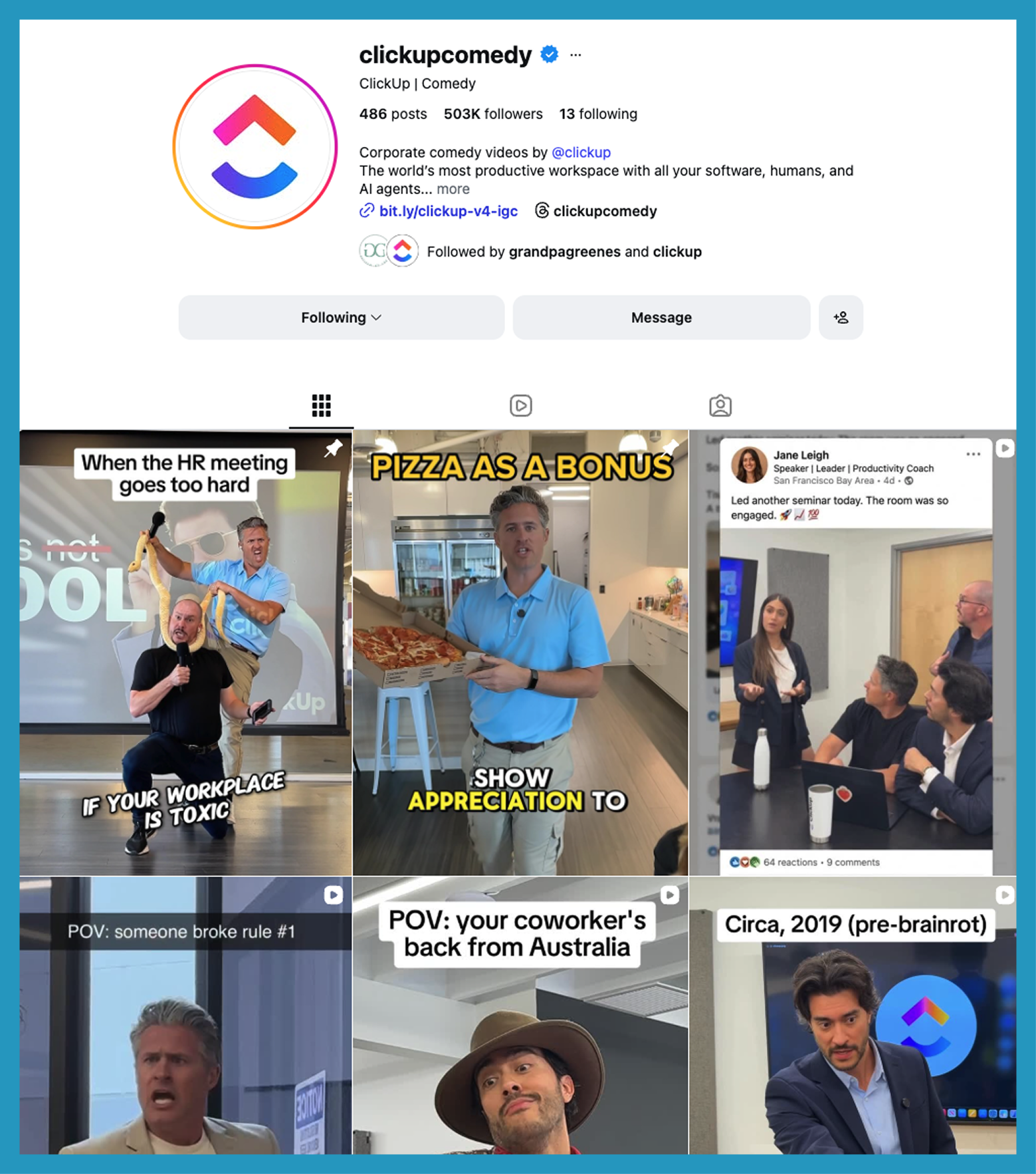
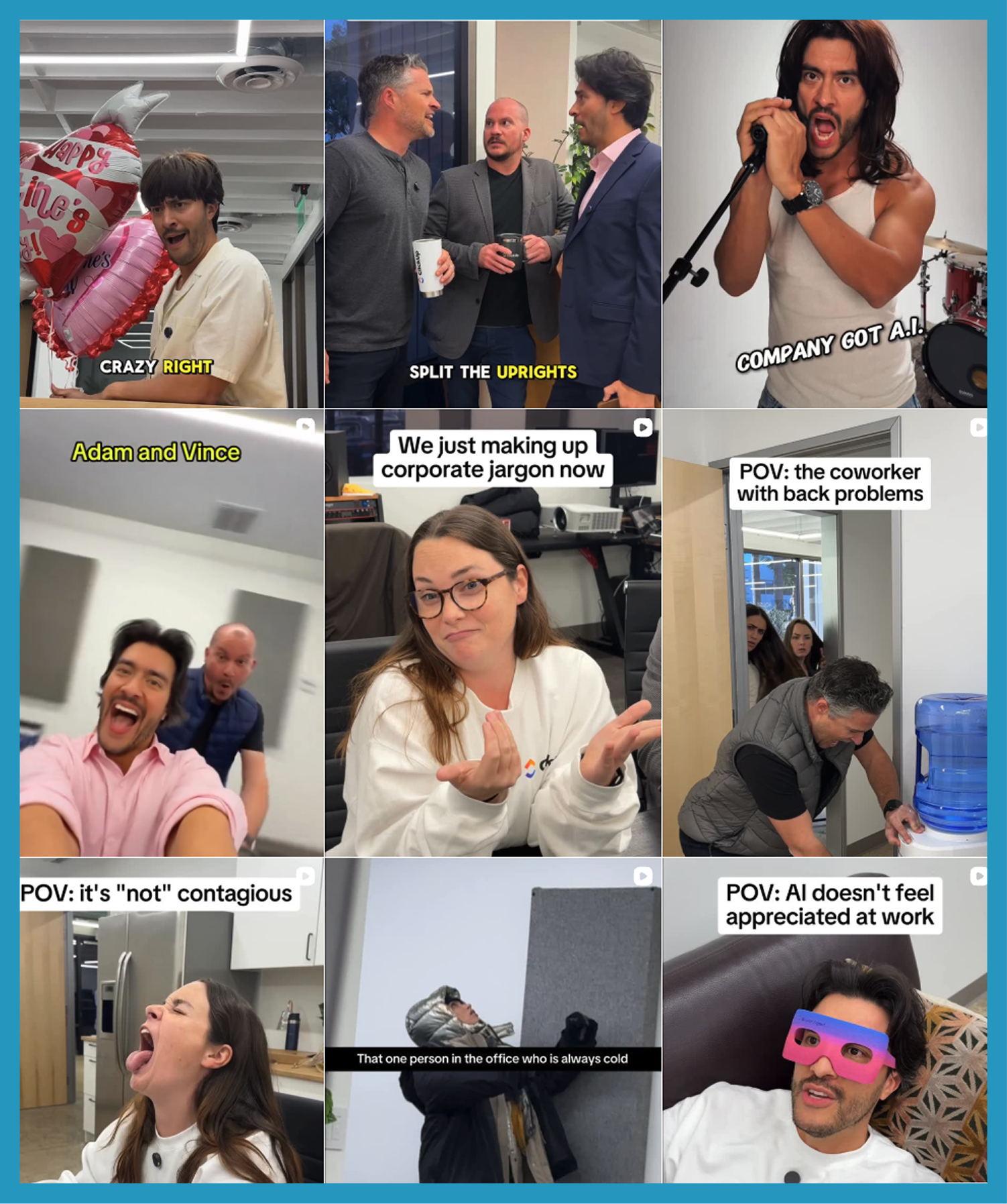
The content is exactly what that tagline suggests: short-form comedy skits about resonant, absurd workplace scenarios.
Getting pizza as a “bonus.”
The ‘office talker’ colleague who talks at you for 45 minutes and you cannot escape.
The way people post on LinkedIn versus how they actually behave.
Crucially, ClickUp didn’t just hand a camera to a marketing intern to run the social media accounts – it’s a core part of their content strategy, and they’re treating it as such.
They hired professional actors and comedians – including people trained at The Groundlings, the LA improv group where Will Ferrell and Kristen Wiig trained.
They run a weekly writers’ room with comedy writers to generate ideas, and treat it like a comedy production operation, not a social media side project.
And they run it as part of a wider ecosystem of accounts – ClickUp Comedy and ClickUp Memes each reach different audiences who’d never follow the main brand account.
When something hits (the team cites individual posts reaching 100M+ views), they joint-post it to the main account too, so the reach flows back.
Why it works:
Entertainment is a legitimate content goal, even in B2B. A lot of B2B content exists to educate, inform, or move someone along a sales funnel. ClickUp Comedy isn’t trying to do any of that – the goal is to make you laugh, to be something you’d share, get their brand in front of as many people as possible, and build brand affinity through a feeling of “ClickUp gets what my work life is actually like”. It’s the kind of content play that’s hard to get buy-in on, because there’s no clean attribution story to lean on, but it absolutely builds the brand recognition that makes you think of them first when you’re evaluating tools.
The comedy works because the subject is universal. Office life is something their entire audience has in common, regardless of role, industry, or seniority. A Head of Marketing and a project coordinator are both potential ClickUp buyers, and will both recognise the “office talker” skit. That universality of office experience enables this content to reach an audience at scale – you don’t need to be a ClickUp user, or even know what ClickUp does, to find it funny. You just need to have worked in an office.
The line between personal and professional is blurrier than B2B brands think. We all have lives outside of work, but it’s not like we’re two entirely different people in work and personal life. The classic B2B channels are the ones we think of as ‘work’ – LinkedIn, search engines, PR outlets. But VP of Sales Sarah is also a person who scrolls TikTok for a 5 minute break after a meeting. Being visible in the spaces where your buyers actually spend their time, when your competitors aren’t, is a smart play.
Treating it like a production means the quality holds up. If you’re going to do comedy as a B2B, you have to do it well – it could so easily fall flat, and have the opposite brand impact that you’re hoping for. ClickUp went and hired professional comedians and improv-trained actors, built a writers’ room, and committed to consistent creative output. The result is content that’s clearly professionally done, and that feels like it belongs on the platform, rather than a brand awkwardly attempting to ‘do TikTok’.
They find repeatable formats, and double down on them. The ClickUp team talk about throwing spaghetti – trying lots of ideas, seeing what hits, analysing why, and doubling down. Consistency, learnings, and iteration are a must for any content project – if you try it once, it flops, and you move onto something new, you’ll never know that you were a step away from it working.
Lessons I’m taking away for my content work:
Know your audience beyond their job title and pain points – how they spend their time outside work and the content they consume just for fun, not for learning.
There are probably platforms or formats we’ve dismissed as “not B2B” that our buyers are actually spending a lot of time on, just not in a work context.
Doing something deliberately, boldly different can make a brand memorable (as long as it’s designed to resonate with our audience so we stand out in the right way).
Creative content that doesn’t land right can do more harm than good. If we’re going to do something unexpected or entertainment-focused, it needs proper production investment behind it.
Give content experiments enough runway to learn from before cutting them. You might be one iteration away from it working.
Kudos to Chris Cunningham and the rest of the ClickUp team involved for this one 👏
What content examples have caught your attention lately? Hit reply and let me know – I’m always on the lookout for the most creative, unique, inspirational examples to cover.
Speak soon,
Your content friend,
Tabitha
P.S. If you found this useful, please share it with a fellow content marketer. Word of mouth is how we grow this little community 🫶