
Why your content audit should be a discipline, not a one-off (+ free content audit template)
New content is great. But your existing library needs attention too – because publishing into a leaky bucket isn't doing us any favours.

Content people love the new and shiny.
There’s always a new topic to cover, a new format to try, a new campaign to run – the backlog of ideas is never-ending and the calendar is always filling up with what’s next.
But if you’re only ever looking forward, you’re publishing into a leaky bucket.
The content you wrote two years ago – the ones that were important enough to be top priority at the time – are left to go stale.
Citations and examples get dated, search rankings slip, and your ICP is still out there looking for valuable insights on that topic.
A regular content audit and refresh process is how you fix the leak
The case for content audits as a discipline, not a one-off process
The standard approach to a content audit is to treat it as a big project run every-so-often.
It’s top-of-the-list when you start a new role and inherit someone else’s library. Or when you introduce a new content strategy and need to see where things are at. Or when traffic declines get bad enough that you can’t ignore them anymore.
A week or two of pulling data, evaluating everything, and assigning actions. Then that’s job done until next time.
I’m guilty of this myself.
At Ravio, I’ve been building our content library for the past three years. We’ve always focused on quality over quantity, so we don’t have a vast library to maintain. But, even so, three years of work means hundreds of blogs, reports, and landing pages amass over time.
Up until now, it’s felt enough to keep on top of it via targeted refreshes for our highest priority SEO pages.
But then recently we found ourselves in an organic search pickle. Traffic and conversions down on pieces that have been performing well for us for years, seemingly overnight, for no clear reason.
I don’t think content freshness and value is the ONLY factor contributing to that, but it’s certainly been a trigger to think about how we can better keep on top of the freshness of our library over time.
So now I’m thinking about the systematic version of content audits and refreshes – how we implement a process that means we’re preventing problems proactively over time, rather than treating refreshes as a bottom-of-the-list priority.
New content is important – but it will always perform better when the library it’s joining is already in good shape.
So my answer hasn’t been about deprioritising new content production for a one-off refresh sprint. Instead, it’s been about figuring out how to build a regular audit and refresh cadence alongside new content production, so that maintenance becomes a discipline rather than a crisis response.
What my content audit process looks like now
The first time you run an audit, it is a big project. There’s no getting around that — you need to build the inventory, pull the data, and evaluate everything from scratch.
But after that first pass, it doesn’t have to be.
My approach has been to get everything into a big template once, with performance data and a clear action assigned to each piece.
From there, checks become lighter – you're maintaining something that already exists rather than starting from scratch each time.
For each piece, there are two things I’m asking when I audit: how is performance trending, and is this content still earning its place in our library (right audience, right intent, right topic, actually contains value, actually says something a competitor couldn’t copy and paste).
I’m also currently building an AI workflow to automate some of the grunt work (as I’m sure we all are) – identifying declining content and flagging suggested actions, so that the audit is constantly happening behind the scenes and that issues get surfaced before they become actual issues rather than requiring a manual data pull every time.
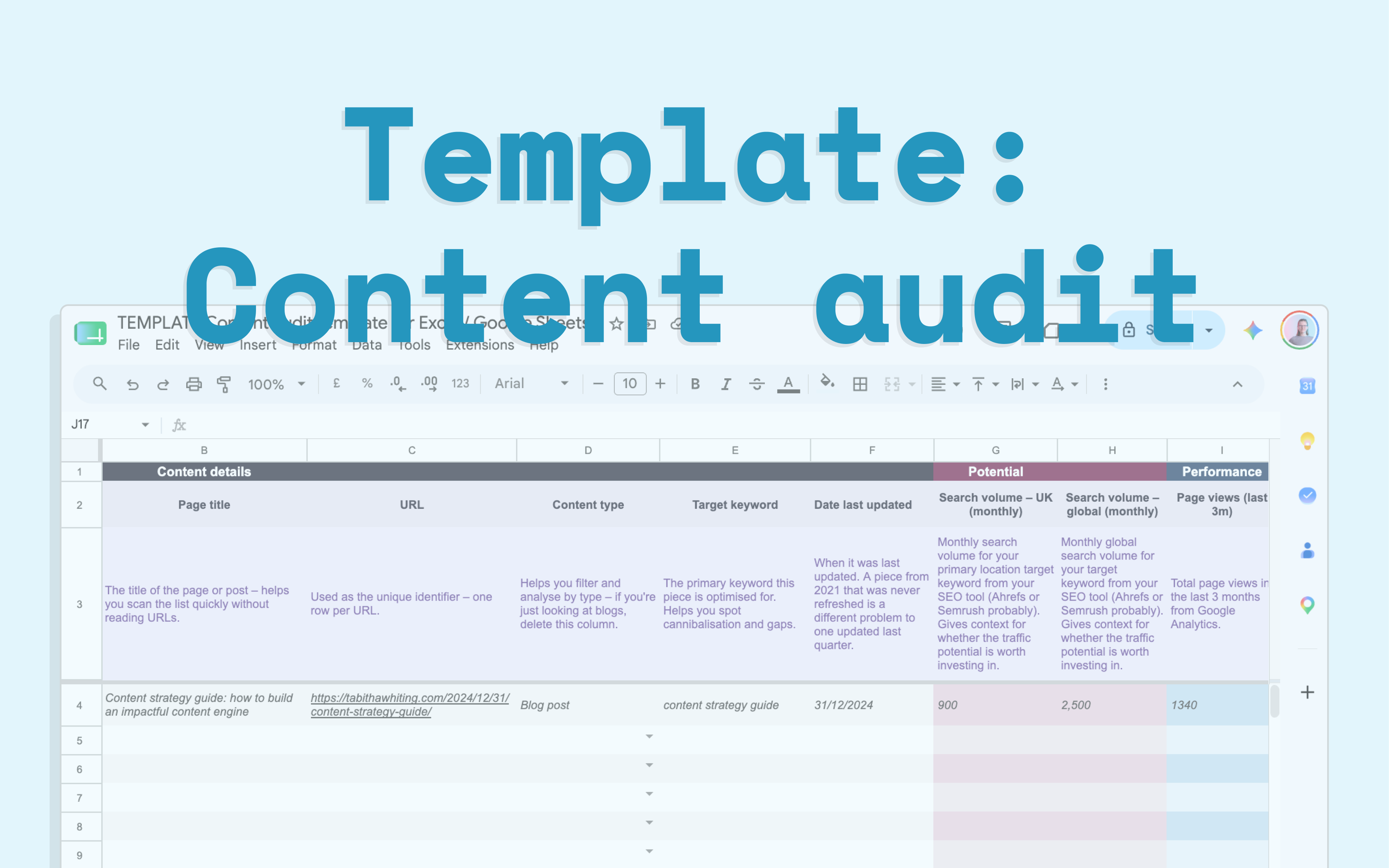
I’ve built a content audit template that makes all of this systematic – if building a regular cadence would be useful, it’s yours to keep.
Speak soon,
Your content friend,
Tabitha